How to Play Clear the Dungeon: The Solo Card Game That Fits in Your Pocket
You've been hired by the King. The assignment: descend into his castle dungeon, clear out every monster lurking in the cells, and do it before your power runs dry. No torches. No teammates. Just you, a deck of cards, and whatever attacks you can scrape together.
That's the premise of Clear the Dungeon, a solo card game by designer Mark S. Ball that plays in about fifteen minutes with a standard 54-card deck. It's tense, satisfying, and genuinely clever. And if you want to skip straight to playing, you can try it right here on Coffee Break Gaming — no setup required.
If you're a fan of dungeon-themed solitaires, you've landed in the right corner of the internet. This is one of several quick solo card adventures we've featured here, alongside the acclaimed Scoundrel and our own pulp sci-fi take on Card Capture. Each game scratches a different itch, and Clear the Dungeon earns its place in that lineup with some genuinely original mechanics.
What You Need
A standard 54-card deck — the full deck including both Jokers. No printing, no tokens, no special components. Grab a flat surface and you're ready.
Setup
Setup takes about two minutes and is easy to memorize after your first game.
Step 1: Pull out all twelve face cards — the four Jacks, four Queens, and four Kings. These form the Dungeon Monster Deck. Shuffle them thoroughly.
Step 2: Deal the twelve monster cards into four columns of three cards each, all face down. Flip the top card of each column face up. You are now looking at four visible monsters, with two more lurking behind each one. That's your dungeon.
Step 3: The remaining forty-two cards — Aces through 10s plus both Jokers — become your Power Deck. Shuffle them and place them face down within reach.
That's it. Four monster columns. One power deck. You're in.
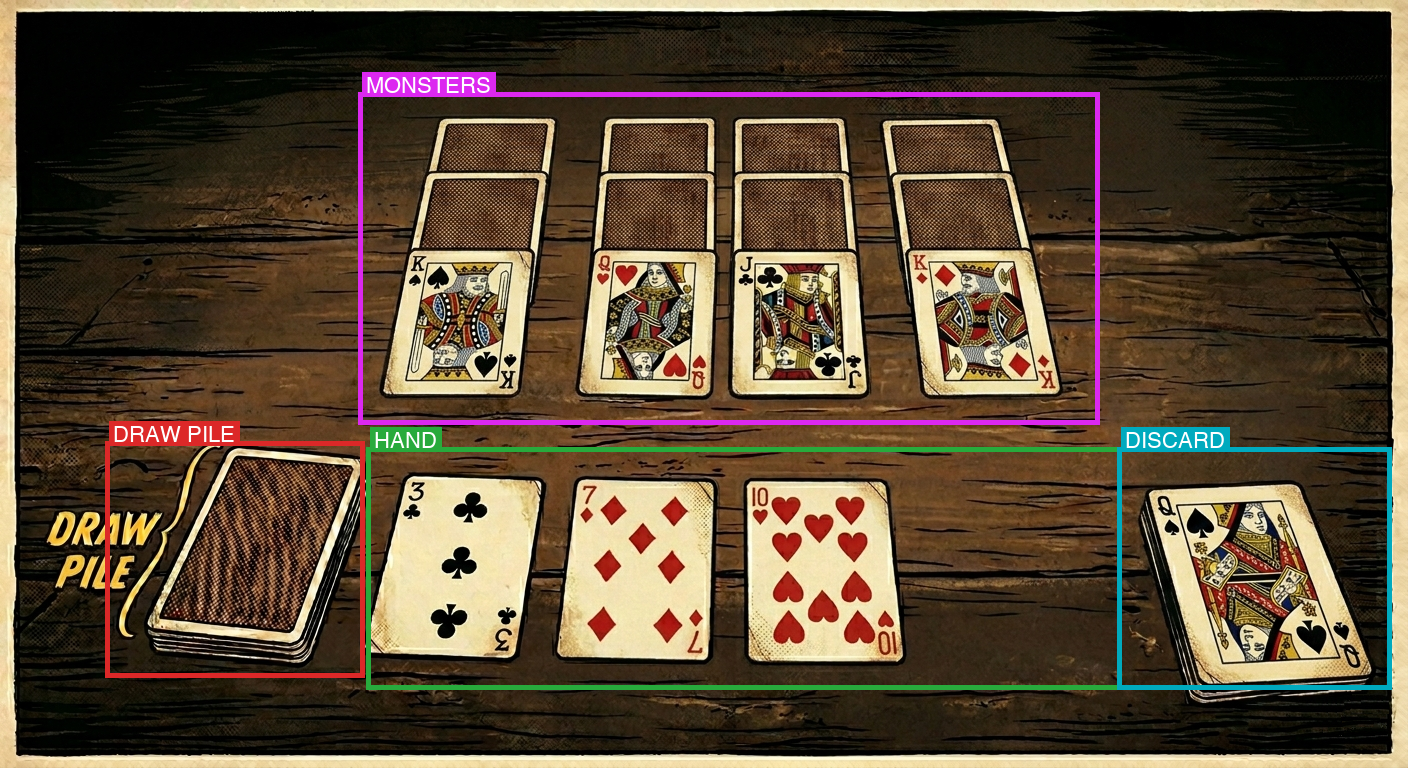
The image above labels the key zones. The four monster columns are outlined in magenta — those face-up cards are your targets. The draw pile (red) is your power deck on the left. The player hand (green) is the three cards you hold each turn. The discard pile (teal) is where unused cards accumulate and where the game can end suddenly.
How to Play: Draw, Attack, Discard
Every turn runs through three phases in order.
Phase 1: Draw
Flip three cards off the top of the Power Deck. These three cards are your entire hand for the turn. There is no holding cards across turns — whatever you draw, you must use or discard before the turn ends. The pressure is constant and stockpiling is impossible.
Phase 2: Attack
Here is where the game lives. Every monster has a power level based on rank: Jacks are worth 11, Queens 12, Kings 13. To defeat a monster you must play exactly three cards on it, obeying two rules.
Rule 1 — Power: The first two cards you place must have a combined value equal to or greater than the monster's power level. To kill a King you need two cards adding up to at least 13. A 7 and a 6 hits exactly 13; an 8 and a 9 gives you 17, which is more than enough.
Rule 2 — Trigger: The third card must match the suit of the monster. This is the trigger, and its rank is completely irrelevant. A 2 of Hearts finishes a Queen of Hearts just as well as a 10 of Hearts. The suit is what kills the monster, not the number.
When the trigger card is played the monster is immediately defeated. Scoop it up with the three attack cards and place them on the Discard Pile — those cards are gone for good. The Power Deck never cycles back, which means every wasted card is a permanent loss.
One monster per turn. You cannot split your three cards across two different enemies.
A Worked Example
You draw the 8 of Clubs, the 5 of Diamonds, and the 3 of Spades. One visible monster is the Jack of Clubs (power level 11).
- Play the 8 of Clubs and the 5 of Diamonds: combined value 13, which exceeds 11. Power requirement met.
- You need a Club to trigger the Jack of Clubs. The 3 of Spades won't work.
No kill this turn. Those cards go to the Damage Pile.
Phase 3: Discard
Any cards you did not use against a monster go face down onto your Damage Pile. If your Damage Pile reaches seven cards at any point, you lose immediately — no exceptions.
This is the game's pressure valve. A couple of bad draws in a row and you are suddenly one turn from losing. Every unused card matters.
The Jokers
Both Jokers live in the Power Deck and are the most flexible cards in the game. A Joker can act as any suit (making it an ideal trigger card when you are missing the right suit) and has a value of up to 10 as an attack card — you choose when you play it. Because they can be anything, Jokers are usually best deployed to solve the specific problem you are facing right now, not held back speculatively.
Winning and Losing
You win by defeating all twelve dungeon monsters. Each time a monster falls, the card beneath it flips face up to reveal the next enemy. The dungeon empties column by column, and when the last face card is cleared the game is over and you have won. Your score is the number of cards remaining in the Power Deck — more cards left means a cleaner, more efficient run.
You lose if the Damage Pile reaches seven cards, or if the Power Deck runs out before all monsters are defeated.
What Makes It Click
The suit-matching trigger is the heart of the game and what sets it apart from simpler dungeon solitaires. Big numbers alone are not enough — you need the right big numbers and a specific suit, all within a hand of three cards. That constraint creates real tension without complicating the rules.
The Damage Pile as a loss condition is equally smart. The game can end suddenly and dramatically, without any slow fade-out. You are either in control or you are not, and the line between those two states can shift in a single bad draw.
The columnized dungeon, where defeating one monster reveals the next, gives each run a satisfying shape. You are not just checking off a list — you are uncovering the dungeon layer by layer.
Play It Now
You can play Clear the Dungeon right here on Coffee Break Gaming, or grab a deck of cards and set it up on your kitchen table in two minutes. The full original rules are available free from Mark S. Ball on his Riffle Shuffle and Roll YouTube channel.
If Clear the Dungeon has you hungry for more solo dungeon action, check out Scoundrel — the acclaimed 2011 design by Zach Gage and Kurt Bieg that pioneered the dungeon-crawler-in-a-deck format. Or if you want something with more strategic depth, our Card Capture: Martian Invasion edition takes an award-winning deck-building solitaire into a pulp sci-fi setting worth exploring. All of them are playable from our main games page.
The dungeon is not going to clear itself.